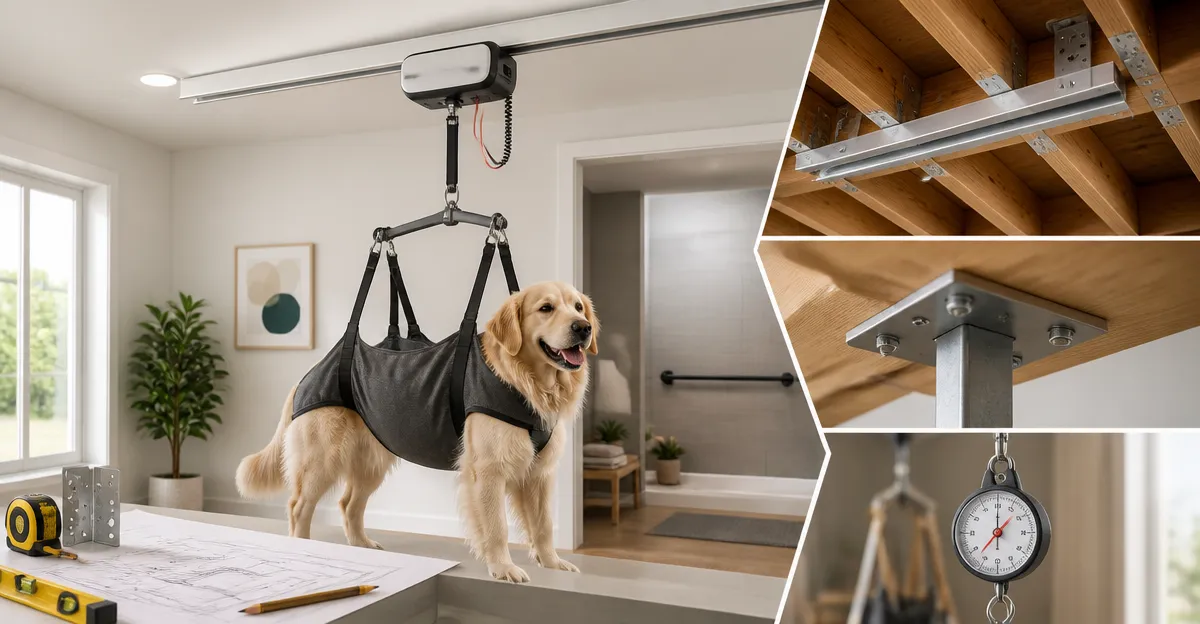
Ultimate Guide: Home Structural Requirements for Installing Ceiling Hoists for Heavy Dogs
Introduction
Installing a ceiling hoist for a large canine companion requires more than simply purchasing a device. One must understand the structural capacity of the home, the regulatory environment, and the specific features of the hoist that will ensure safe, reliable operation. This guide explains the essential concepts, provides step‑by‑step recommendations, and highlights three Amazon products that complement a well‑designed installation.
Readers will learn how to assess joist strength, select appropriate mounting hardware, integrate electrical power safely, and choose a hoist that matches the dog’s weight and the homeowner’s space constraints. The information presented is based on industry standards and real‑world experience, allowing readers to make informed decisions without relying solely on product marketing.
By the end of this guide, one will be able to evaluate a home’s suitability for a ceiling hoist, compare leading lifts, and follow best‑practice installation procedures that protect both the animal and the caregiver.
Background and Context
Ceiling hoists were originally designed for patient transfer in medical facilities. The same mechanical principles apply when lifting a heavy dog, but the load distribution and usage patterns differ. A typical large dog can weigh between 80 and 150 pounds; however, some breeds exceed 200 pounds, requiring lifts rated for at least 340 lb. The primary structural element involved is the ceiling joist, which must support the combined weight of the dog, the lift, and dynamic forces generated during movement.
Key terminology includes:
- Live load: The weight applied to a structural member during normal use, such as a dog in a lift.
- Dead load: The permanent weight of the lift hardware and mounting brackets.
- Factor of safety: A multiplier applied to the calculated load to ensure the structure can handle unexpected stresses.
Building codes in the United States, such as the International Residential Code (IRC), specify minimum joist sizes and spacing for residential floors. For ceiling installations, the same joist dimensions apply, but additional reinforcement may be required if the calculated load exceeds the joist’s rated capacity.
Understanding these concepts provides the foundation for evaluating whether a home can safely accommodate a ceiling hoist for a heavy dog.
Assessing Structural Load Capacity
The first step is to identify the joist material, size, and spacing. Common residential joists are 2×8, 2×10, or engineered I‑joists spaced 16 inches on center. Manufacturer span tables indicate the maximum uniform load each joist can support. For example, a 2×10 joist spanning 12 feet at 16‑inch spacing typically carries a live load of 40 lb/ft².
To calculate the load imposed by a ceiling hoist, follow these steps:
- Determine the total weight: dog weight + lift weight + bracket weight. For a 150‑lb dog and a lift rated at 340 lb, the total is approximately 490 lb.
- Convert the total weight to a uniform load by dividing by the joist span length. If the span is 12 feet, the uniform load is 490 lb ÷ 12 ft ≈ 41 lb/ft.
- Add the existing live load (typically 40 lb/ft² for residential floors) to obtain the combined load.
- Apply a factor of safety of 1.5 to the combined load. In this example, (41 + 40) × 1.5 ≈ 122 lb/ft, which exceeds the joist’s capacity.
If the calculated load surpasses the joist rating, reinforcement is required. Options include installing a sister joist, adding a support beam, or using a ceiling plate that distributes the load across multiple joists.
Consult a licensed structural engineer before proceeding with any reinforcement, especially in older homes with unknown modifications.
Selecting the Appropriate Ceiling Mount
The mounting hardware must securely attach to the joist without causing splitting or crushing. Heavy‑duty steel brackets rated for at least 500 lb are recommended. The bracket should have a wide bearing plate to spread the load over a larger area of the joist.
When installing the bracket, use lag bolts of minimum 5/16 inch diameter, pre‑drilled to avoid wood fiber compression. Apply a washer under the head of each bolt to increase surface area. Verify that the bracket aligns with the lift’s center of gravity to prevent pendulum motion during operation.
For homes with plaster or drywall ceilings, a ceiling joist locator tool can help locate the joist without damaging the surface. After locating the joist, cut a small inspection hole, confirm the joist dimensions, and then seal the opening after installation.
Electrical Considerations for Powered Lifts
Battery‑powered lifts, such as the Joerns Hoyer Advance Portable Electric Lift, reduce the need for permanent wiring but still require safe charging practices. If a wired lift is preferred, install a dedicated 120 V circuit with a ground‑fault circuit interrupter (GFCI) to protect against electrical shock.
Run the power cable through a conduit that meets National Electrical Code (NEC) requirements. Secure the conduit to the joist using non‑metallic clamps, and avoid routing the cable near water sources such as bathrooms or laundry rooms.
For battery‑powered models, store the battery in a well‑ventilated area and follow the manufacturer’s charging schedule. The Joerns lift includes a removable battery pack with indicator lights, allowing caregivers to monitor charge status without opening the device.
Choosing the Right Lift System
Three products are particularly relevant for heavy‑dog ceiling hoist installations:
- Joerns Hoyer Advance Portable Electric Lift – Rated for 340 lb, battery powered, folds for transport, and features a swan‑neck design that minimizes clearance requirements.
- Vive Gait Belt – Provides a secure handle for caregivers when manually guiding the dog onto the lift platform; supports up to 350 lb.
- Vive Portable Electric Patient Lift – Offers a higher weight capacity of 400 lb and an adjustable base, suitable for larger breeds or multi‑dog households.
When selecting a lift, consider the following criteria:
| Criteria | Joerns Hoyer Advance | Vive Gait Belt | Vive Portable Electric Lift |
|---|---|---|---|
| Maximum Load | 340 lb | 350 lb (handles only) | 400 lb |
| Power Source | Battery | None (manual) | Battery with removable pack |
| Portability | Foldable, 69.9 lb | Lightweight, 2 lb | Portable, 124 lb |
| Rating (out of 5) | 4.6 (104 reviews) | 4.5 (10,397 reviews) | 4.2 (10 reviews) |
| Price (USD) | $2,518.00 | $17.89 | $824.99 |
For most heavy‑dog scenarios, the Joerns lift provides a balanced combination of load capacity, portability, and quiet operation. The Vive gait belt is an inexpensive adjunct that improves caregiver ergonomics during transfers. The Vive portable lift is appropriate when a higher capacity is required or when the ceiling structure cannot support a permanent mount.
Comparison and Selection Guide
To assist readers in choosing the most suitable product, the following decision matrix is provided:
- If the dog weighs under 300 lb and the ceiling joist can support a 340 lb load, select the Joerns Hoyer Advance Portable Electric Lift for its ease of use and quiet battery operation.
- If the ceiling cannot accommodate a permanent mount but a temporary solution is acceptable, the Vive Portable Electric Patient Lift can be positioned on a sturdy floor stand, reducing ceiling load concerns.
- If budget constraints dominate and manual assistance is feasible, the Vive Gait Belt offers a cost‑effective method to guide the dog onto a simple platform or sling.
Each option should be evaluated against the structural analysis performed in the earlier sections. The chosen lift must never exceed the calculated safe load for the joist system.
Best Practices & Tips
- Perform a load‑capacity calculation before purchasing any lift. Use a spreadsheet to document joist dimensions, span, and safety factors.
- Engage a qualified electrician when installing permanent wiring for powered lifts. Verify that the circuit is GFCI‑protected.
- Install a ceiling plate that spans at least two joists to distribute the load evenly. Steel plates with pre‑drilled holes simplify bolt alignment.
- Test the lift with a weighted dummy before using it on the dog. Observe for any wobble or excessive strain on the mounting hardware.
- Maintain the lift according to the manufacturer’s schedule. Replace batteries that no longer hold a charge above 80 % capacity.
- Store the gait belt in a clean, dry location to prevent strap degradation. Inspect the metal buckle for signs of wear before each use.
- Document the installation with photos and keep a copy of the structural engineer’s report for future reference or resale of the home.
Frequently Asked Questions
- Can a ceiling hoist be installed in a finished drywall ceiling?
- Yes, provided the joist is located and a reinforcement plate is used. Cutting a small inspection hole helps verify joist dimensions before mounting.
- What is the minimum recommended height for a ceiling lift?
- The lift should be able to raise the dog at least 66 inches from the floor, as specified by the Joerns model, to accommodate most beds and sofas.
- Do I need a professional to install the mounting brackets?
- While a competent DIYer can install brackets, a licensed contractor ensures compliance with local building codes and reduces liability.
- How often should the battery be charged?
- Follow the manufacturer’s recommendation; typically, a full charge after each use extends battery life and ensures readiness for emergencies.
- Is a gait belt necessary if I use an electric lift?
- A gait belt is not required for lift operation, but it assists caregivers in guiding the dog onto the sling, improving safety and reducing strain.
- Can I use the lift outdoors?
- Most ceiling lifts are intended for indoor use. Exposure to moisture or extreme temperatures can damage electrical components and void warranties.
Conclusion
Installing a ceiling hoist for a heavy dog is a multidisciplinary task that blends structural engineering, electrical safety, and ergonomic product selection. By assessing joist capacity, reinforcing the ceiling as needed, and choosing a lift that matches the dog’s weight and the home’s layout, caregivers can provide a safe, dignified transfer solution. The products highlighted in this guide illustrate how modern technology can simplify the process while maintaining rigorous safety standards.
When the proper calculations, professional consultations, and maintenance routines are followed, a ceiling hoist becomes a reliable asset that enhances quality of life for both the dog and its caregiver.
Products Featured in This Guide
Joerns Hoyer Advance Portable Electric Lift
Price: $2,518.00
Rating: 4.6/5.0 (104 reviews)
Featured because it offers a 340 lb capacity, battery operation, and a compact swan‑neck design that fits within typical residential ceiling heights.
Vive Gait Belt
Price: $17.89
Rating: 4.5/5.0 (10,397 reviews)
Featured because it provides a low‑cost, ergonomic solution for caregivers to guide dogs onto lifts, reducing strain and improving safety.
Vive Portable Electric Patient Lift
Price: $824.99
Rating: 4.2/5.0 (10 reviews)
Featured because it supports up to 400 lb, includes an adjustable base, and offers a removable battery, making it suitable for larger breeds or homes with limited ceiling load capacity.