How to Create Home Navigation Cues for Visually Impaired Dogs: A Step‑by‑Step Guide
Introduction
Visually impaired dogs rely on senses other than sight to move safely through their environment. This guide explains how owners can transform a typical home into a supportive, low‑stress space that encourages independence. Readers will learn the science behind canine perception, practical cue‑creation techniques, and how to select harnesses that reinforce safety. By the end of the article, one will have a clear plan for designing tactile pathways, scent markers, and auditory signals that work together seamlessly.
Background/Context
Canine vision differs from human vision in that dogs see fewer colors and have a narrower field of view. When vision is compromised, dogs compensate with heightened hearing, smell, and touch. Understanding these compensatory mechanisms is essential for creating cues that are both intuitive and reliable. Additionally, a well‑fitted, non‑choking harness provides a physical anchor that can amplify the effectiveness of any cue system.
Understanding Visual Impairment in Dogs
Visual impairment in dogs can result from congenital conditions, injury, or progressive diseases such as cataracts and retinal degeneration. Affected dogs often exhibit hesitation at thresholds, bumping into furniture, or reluctance to use stairs. The key to helping them is to reduce uncertainty by providing consistent, multimodal information. When cues are predictable, the dog learns to associate a specific texture, scent, or sound with a safe route.
Designing Effective Home Navigation Cues
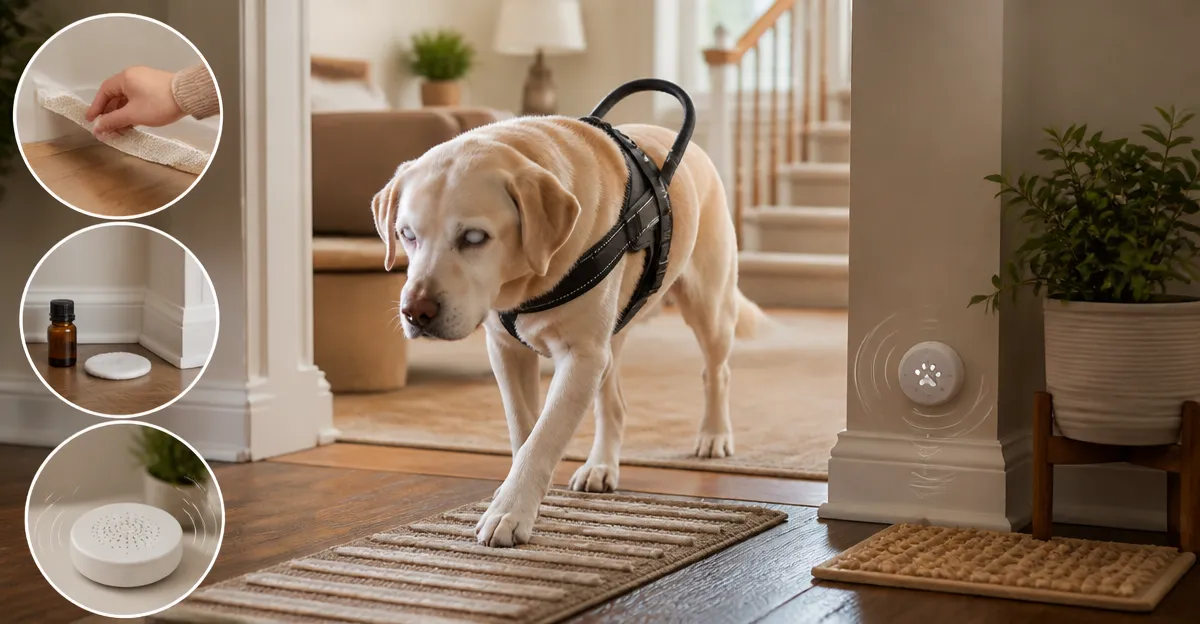
Successful cue design combines three core elements: tactile pathways, scent markers, and auditory signals. Tactile pathways are created using non‑slip mats, textured runners, or low‑profile rubber strips that guide the dog’s paws. Scent markers employ mild, dog‑safe aromas such as lavender or chamomile placed at decision points; the scent should be subtle enough to avoid overstimulation. Auditory signals include gentle chimes, clickers, or recorded footsteps that activate when the dog approaches a turning point.
To reinforce these cues, a secure harness with a handle and reflective strips can provide physical guidance and added confidence during low‑light conditions. The rabbitgoo No Pull Dog Harness offers a front‑clip that discourages pulling, a padded interior for comfort, and bright reflective stitching that enhances visibility. Its adjustable straps accommodate growth, making it suitable for medium to large breeds that need a sturdy anchor while navigating home obstacles.
When selecting a harness, consider the following features: a front leash attachment for redirecting movement, a sturdy handle for gentle lifting, breathable mesh for all‑weather comfort, and reflective elements for nighttime safety. The harness should also be easy to put on and remove, as frequent adjustments are common during training sessions.
Implementing Cues Room by Room
Living Room: Place a low‑friction rubber runner along the main traffic lane. Attach a small scented pad at the entrance to the hallway; the dog will learn that the scent signals a transition zone. A soft clicker can be activated when the dog reaches the runner’s end, reinforcing the cue with an auditory cue.
Kitchen: Use a textured mat in front of the sink to delineate a safe standing area. The PHOEPET No Pull Dog Harness includes a back handle that assists owners in gently guiding the dog away from hot surfaces. Its reflective material adds an extra layer of safety if the kitchen lighting is dim.
Stairs: Install short, non‑slip stair treads with a contrasting color strip. A faint vanilla scent applied to the first step helps the dog anticipate the ascent. The Voyager Step‑in Dog Harness features a step‑in design that eliminates the need to pull the harness over the head, reducing stress when approaching stairs.
Bathroom: Lay a rubber mat with a raised edge to define the area. A gentle water‑proof scent pad can be placed near the tub to signal a wet zone. The Annchwool No Pull Dog Harness provides a soft padded handle that makes it easy to lift the dog safely out of a bathtub or onto a high surface.
Bedroom: Use a low‑profile carpet runner that leads to the dog’s bed. A calming lavender scent can be added to the runner’s ends to promote relaxation. The ShawnCo Essential Dog Harness includes three leash attachment points, allowing owners to experiment with front‑clip guidance while the dog learns the bedtime routine.
Training Your Dog to Use Cues
Begin training in a distraction‑free environment. Introduce one cue at a time, rewarding the dog with a treat and verbal praise when it follows the tactile or scented path correctly. Use the harness handle to gently guide the dog if it hesitates, but avoid pulling; the goal is to let the dog make its own decisions based on the cues.
Practice short sessions of 5‑10 minutes, gradually increasing duration as confidence grows. Consistency is vital; always place the same scent and texture in the same location until the dog reliably follows the path. Over time, incorporate mild background noises such as a ticking clock to simulate real‑world auditory complexity.
Document progress in a simple log, noting the cue type, the dog’s response, and any adjustments made to harness fit. Adjust strap tension if the harness slides or feels loose, as a secure fit prevents accidental unfastening during active navigation.
Finally, reinforce successful navigation with a calm, enthusiastic voice. Positive reinforcement solidifies the association between the cue and the desired movement, making the home environment a safe sanctuary for a visually impaired companion.
Comparison/Selection Guide
| Product | Key Features for Navigation Cues | Price | Rating (Reviews) |
|---|---|---|---|
| rabbitgoo No Pull Dog Harness | Front and back metal rings, padded interior, reflective strips, adjustable 4‑strap system | $19.98 | 4.5/5 (196,724) |
| PHOEPET No Pull Dog Harness | Three buckles for easy on/off, dual metal loops, reflective material, soft handle | $15.83 | 4.5/5 (29,665) |
| Voyager Step‑in Dog Harness | Step‑in design, breathable air mesh, double D‑rings, reflective bands | $11.99 | 4.5/5 (69,374) |
| Annchwool No Pull Dog Harness | Soft padded handle, O‑ring and D‑ring combo, reflective stitching, five size options | $18.99 | 4.4/5 (6,260) |
| ShawnCo Essential Dog Harness | Three leash attachment points, heavy‑duty nylon, reflective trim, rapid on/off | $27.95 | 4.4/5 (20,899) |
When choosing a harness, match the dog’s size with the product’s adjustable range, prioritize a front‑clip if the dog tends to pull, and select reflective features for low‑light navigation. The table above highlights which models excel in each of these categories.
Best Practices & Tips
- Maintain consistent scent locations; moving a scented pad frequently confuses the dog.
- Use low‑profile, non‑slip materials for tactile pathways to avoid tripping hazards.
- Test auditory cues at different volumes; a cue that is too loud can startle a sensitive dog.
- Regularly inspect harness stitching and reflective strips for wear; replace when fraying occurs.
- Rotate harnesses between indoor and outdoor use to keep the dog accustomed to varied textures.
FAQ
- How long does it take for a visually impaired dog to learn home cues?
- Most dogs show noticeable improvement after 2‑3 weeks of short, consistent training sessions.
- Can I use the same harness for indoor and outdoor navigation?
- Yes, provided the harness is weather‑resistant and has reflective elements for outdoor safety.
- What if my dog is a strong puller?
- Choose a harness with a front‑clip, such as the rabbitgoo or ShawnCo models, to redirect pulling without choking.
- Are scented pads safe for dogs with allergies?
- Use hypoallergenic, dog‑safe essential oils in very low concentrations; always monitor for skin irritation.
- How often should I adjust the harness straps?
- Check strap tension weekly, especially after weight changes or after bathing, to ensure a snug but comfortable fit.
Conclusion
Creating a home environment that supports a visually impaired dog requires thoughtful integration of tactile, scent, and sound cues, combined with a well‑chosen harness that offers safety and comfort. By following the step‑by‑step strategies outlined in this guide, owners can empower their dogs to navigate confidently, reduce anxiety, and enjoy a higher quality of life. Consistency, patience, and the right equipment are the three pillars of success.
Products Featured in This Guide
rabbitgoo No Pull Dog Harness
Price: $19.98 | Rating: 4.5/5 (196,724 reviews)
Featured for its front‑clip, padded interior, and reflective strips that aid low‑light navigation and provide a secure handle for gentle guidance.
PHOEPET No Pull Dog Harness
Price: $15.83 | Rating: 4.5/5 (29,665 reviews)
Featured for its three‑buckle easy‑on design, dual metal loops, and reflective material that enhances safety during night‑time indoor walks.
Voyager Step-in Dog Harness
Price: $11.99 | Rating: 4.5/5 (69,374 reviews)
Featured for its step‑in design that eliminates head‑pulling, breathable air mesh, and reflective bands suitable for small‑breed navigation.
Annchwool No Pull Dog Harness
Price: $18.99 | Rating: 4.4/5 (6,260 reviews)
Featured for its soft padded handle, dual O‑ring/D‑ring system, and reflective stitching that aid both control and visibility.
ShawnCo Essential Dog Harness
Price: $27.95 | Rating: 4.4/5 (20,899 reviews)
Featured for its three leash attachment points, heavy‑duty construction, and reflective trim, making it ideal for training and nighttime walks.
Frequently Asked Questions
What are the best materials for tactile pathways to guide a visually impaired dog at home?
Use low‑profile, non‑slip rugs, textured floor runners, or rubber mat strips that contrast in texture and are securely anchored.
How can I create effective scent markers without confusing my dog?
Place a small amount of a consistent, mild scent (e.g., lavender oil on a cotton pad) at key locations and refresh it every few weeks.
What features should I look for in a harness for a visually impaired dog?
Choose a well‑fitted, padded harness with a secure, non‑choking design and attachment points for cue devices or leashes.
How often should I rotate or update navigation cues in my home?
Refresh tactile and scent cues every 1–2 months, and vary auditory signals weekly to keep the dog responsive.
Can auditory signals be used safely without overwhelming a visually impaired dog?
Yes; use gentle, distinct sounds like soft chimes or clickers placed near obstacles, keeping volume low and limiting the number of cues per area.