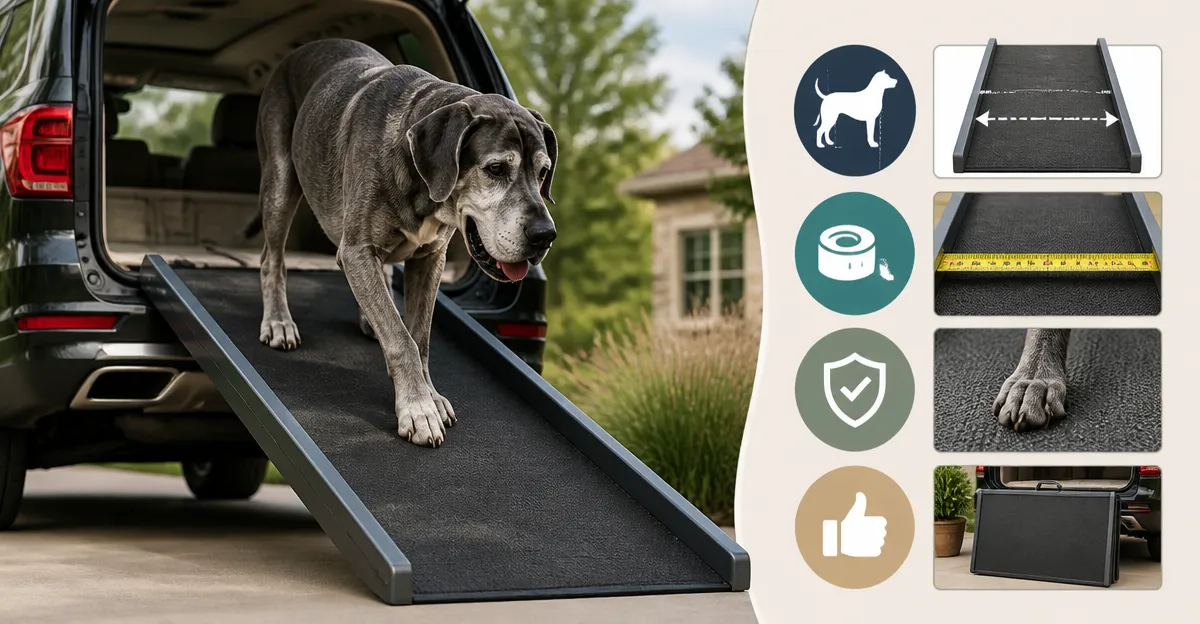
How to Choose the Ideal Ramp Width for Giant Senior Dogs: A Step-by-Step Guide
This guide explains how to determine the optimal ramp width for large senior dogs. One will learn how to measure a dog, evaluate mobility limitations, and select a ramp that provides safety and comfort. The information is valuable because an improperly sized ramp can cause joint strain, slips, or injuries. By following the steps, owners can enhance their pets' independence while protecting fragile joints.
What You Will Need
- Measuring tape or ruler
- Notebook or digital device for recording measurements
- Non‑slip surface material for testing (optional)
- Access to a sturdy, level surface for trial assembly
- 63in Folding Portable Dog Car Ramp (recommended for width testing)
- DOK Inflatable Dog Dock (recommended for water‑based scenarios)
Step 1: Measure Your Dog’s Body Width and Stance
Begin by measuring the widest part of the dog’s thorax while the animal is standing naturally. Use a flexible measuring tape and record the measurement in inches. Next, measure the distance between the outer edges of the front paws when the dog is in a relaxed stance; this provides the functional width that the ramp must accommodate. For giant breeds, typical widths range from 14 to 18 inches, but senior dogs may require additional clearance due to arthritis‑induced gait changes.
Record both measurements in a notebook. The larger of the two numbers will serve as the baseline for selecting a ramp width. It is essential to add a safety margin of at least 2 inches to prevent the dog’s paws from brushing the ramp edges.
Step 2: Determine the Ideal Ramp Width
Using the recorded measurements, calculate the minimum ramp width by adding the safety margin. For example, a dog with a thoracic width of 16 inches will need a ramp at least 18 inches wide. Selecting a ramp that exceeds this minimum by 2 to 4 inches improves stability because the dog can position its body centrally without feeling constrained.
When evaluating commercial ramps, compare the advertised width with the calculated requirement. The 63in Folding Portable Dog Car Ramp offers a width of 17.3 inches, which meets the needs of many giant senior dogs while providing a compact folding profile for storage. Its width falls within the recommended range for dogs up to 250 lb, making it a versatile choice for both vehicle entry and indoor steps.
Step 3: Evaluate Surface Material and Traction
Senior dogs often experience reduced grip due to joint pain or diminished muscle tone. A ramp surface that combines softness with high‑traction reduces the risk of slipping. The carpeted surface on the 63in Folding Portable Dog Car Ramp consists of dense anti‑tear fibers with a Loofah‑like texture, providing ample grip while cushioning impact on the paws.
For water‑based activities, the DOK Inflatable Dog Dock incorporates EVA foam with a patented full‑traction deck. This material remains slip‑free when wet and offers a gentle slope for dogs that dislike steep angles. The dock’s width of 40 inches far exceeds the minimum requirement, ensuring that even the broadest senior dogs can traverse the surface without fear of falling.
Step 4: Choose Between Portable and Fixed Ramps
Consider the environments in which the ramp will be used. A portable ramp, such as the 63‑inch folding model, can be moved between vehicles, patios, and indoor furniture. Its quadruple‑fold design reduces the folded dimensions to 17.5 × 17 × 5.5 inches, allowing storage in a car trunk or closet. Portability is essential for owners who travel frequently or who need a ramp for multiple locations.
Fixed ramps are typically installed at a single site, such as a permanent step leading to a raised bed. While fixed ramps can be customized for exact dimensions, they lack the flexibility of a portable solution. For senior dogs that require consistent access to a specific area, a fixed ramp may be appropriate, but the guide emphasizes portable options because they accommodate changing needs.
Step 5: Assess Load Capacity and Structural Stability
Both products listed support a maximum weight of 250 lb, which comfortably covers most giant senior dogs. The 63in Folding Portable Dog Car Ramp achieves stability through an internal load‑bearing crossbar that distributes weight evenly across the aluminum frame. This engineering feature prevents flexing under load, thereby protecting the dog’s joints during ascent and descent.
The DOK Inflatable Dog Dock relies on weighted mesh and a reinforced air chamber to maintain rigidity on water. Its design includes stainless‑steel buckles and safety ropes that secure the dock to a boat or pool edge, preventing drift. When selecting a ramp, verify that the advertised load capacity exceeds the dog’s actual weight by at least 20 percent to account for dynamic forces.
Step 6: Test Installation and Safety Features
After selecting a ramp, assemble it according to the manufacturer’s instructions. Verify that all locking mechanisms engage securely and that the ramp rests on a level surface. For the folding car ramp, engage the safety rope and stainless‑steel buckles before allowing the dog to use the ramp. This extra security prevents accidental collapse.
Conduct a trial run with the dog on a leash. Observe the animal’s gait, checking for hesitancy or slipping. Adjust the angle if necessary; a longer ramp length, such as the 63‑inch model, yields a gentler incline that reduces joint strain. For the inflatable dock, inflate fully and ensure the air pressure is within the recommended range before allowing water entry.
Tips & Pro Tips
- Always place a non‑slip mat at the base of the ramp to prevent movement on smooth floors.
- For outdoor use, store the ramp in a dry location to avoid corrosion of metal components.
- Consider adding reflective tape to the ramp edges for visibility in low‑light conditions.
- Regularly inspect the carpet fibers or EVA foam for wear; replace the ramp when traction diminishes.
- Use a harness rather than a collar when guiding a senior dog onto a ramp to avoid neck strain.
Troubleshooting
Problem: Dog hesitates at the top of the ramp.
Solution: Place a treat or favorite toy at the far end to encourage forward movement. Reduce the incline by extending the ramp if possible.
Problem: Ramp surface becomes slippery when wet.
Solution: Apply a non‑slip spray designed for pet equipment or use the DOK Inflatable Dog Dock, which maintains traction in wet conditions.
Problem: Ramp collapses under weight.
Solution: Verify that all locking pins are fully engaged and that the load does not exceed 250 lb. If the problem persists, contact the manufacturer for a replacement.
Conclusion
Choosing the correct ramp width for a giant senior dog involves precise measurement, consideration of surface traction, and evaluation of portability versus permanence. By following the six steps outlined in this guide, owners can select a ramp that safeguards joint health, reduces the risk of falls, and enhances the dog’s independence. The recommended 63in Folding Portable Dog Car Ramp and DOK Inflatable Dog Dock exemplify products that meet the criteria for width, stability, and comfort.
Products Mentioned in This Guide
Frequently Asked Questions
How do I measure the correct ramp width for my giant senior dog?
Measure the widest part of the dog’s thorax and add a few inches for comfortable clearance, then choose a ramp at least that wide.
Why is ramp width important for senior dogs?
A properly wide ramp prevents the dog from slipping or having to balance on a narrow surface, reducing joint strain and injury risk.
What is the minimum recommended ramp width for large senior dogs?
For giant breeds, aim for a ramp at least 24‑30 inches wide to accommodate their size and provide stability.
Can I test a ramp’s width before buying?
Yes, use a portable folding ramp or place a non‑slip mat on the surface to simulate the width and observe your dog’s comfort.
Do inflatable ramps work for senior dogs with mobility issues?
Inflatable ramps can be safe if they have a firm, non‑slip surface and are wide enough; they’re best for temporary or water‑based use.